

Submit a request for information to see how Cayuse can help free up time spent on administrative tasks for a bigger impact and better job satisfaction.
Blog
New Strategies for Better Workload Assessments
- Higher Education
Workload assessments are critical for managing any research administration team. Between budgets, staff, and hours in a week, research departments must contend with a limited resource pool and make the most of what they have. This means a delicate balance between effectively allocating the resources available and preventing staff burnout.
Conducting accurate workload assessments can help keep this balance and ensure your staff and resources are optimally allocated to drive results and maintain employee satisfaction. However, certain flaws in traditional workload assessment calculations can create an inaccurate picture of your team’s status, leading to decisions that can unintentionally damage efficiency and morale.
For this reason, Cayuse was honored to host Duke University’s Lacey Rhea for a discussion on taking a more realistic approach to staffing research administration offices and making sure workload assessments accurately reflect reality.
In this blog, we’ll review the key takeaways from Lacey’s presentation, the full recording of which is available to watch on demand here.
Flaws in traditional workload measurements
The traditional method for calculating workload measurements consists of four main steps:
- List transactional tasks: Build a thorough list of your team’s transactional tasks. These are the tasks for which you and your team are responsible to complete your work.
- Quantify time to complete each task: Break down all of your transactional tasks from the first step into the number of hours they require for completion.
- Gather transaction-level metrics: Compile metrics for how many of the transactional tasks from the first step your unit performs in a given time period.
- Calculate how many full-time employees (FTE) are needed based on 2,080 person-hours: Using the information gathered in the first three steps, you can now calculate the number of employees needed in a year consisting of 2,080 work hours (40 hours each week times 52 weeks each year. The traditional formula can be abbreviated as (N*H)/2,080=FTE, where N equals the number of tasks, and H equals the hours required to complete these tasks.
While this process is standard in many organizations, it contains several potentially flawed assumptions that can undermine the accuracy of the resulting workload calculations:
No industry standard for workload measurement
Generally, there are few consistent industry standards for measuring workload assessments in a research administration environment. This is largely due to the unavoidable fact that each research institution is different, with factors from research volumes to state regulations affecting the workflows, roles, and culture in any given office. Two people from different organizations may have the same Research Administrator title, but their responsibilities may be wildly different, even if their teams are a similar size and their research covers the same fields.
This means that there are rarely one-size-fits-all answers to questions like “how many staff members do we need for our office?” or “how do you decide how to allocate tasks?” in the field of research administration. Instead, workload assessments must be tailored to individual organizations to ensure accuracy.
No faculty-to-staff ratio in the university budget process
This next flaw is specific to university research environments. In short, whenever a research university is setting priorities and determining how to spend funds, the number of faculty that are being brought is not right-sized with the number of staff. Faculty-to-staff ratios and student-to-staff ratios are usually not factored into budgets, despite the impact these values can have on time commitments for each member of the team.
Budget-based vs needs-based staffing
Continuing from the previous point, research teams often operate under a budget-based staffing model, rather than one designed around staffing needs.
For example, a medical school may be allocated more funding and FTEs than a physics department simply because it brings in more money for indirect costs. Resources allocated to different departments will inevitably vary by the size and priority of each discipline, even if the work they’re conducting is essentially the same.
Transaction-centered measurements for cognitive-centered work
Despite being commonplace in HR departments, most members of any given team don’t work exactly 2,080 hours a year.
The standard “2,080 hours” measurement for a work year does not reflect time spent on holidays, vacations, and mental health breaks—all of which are necessary for preventing burnout. It also doesn’t differentiate time for meetings, continuing education, critical thinking, and reflection, all of which are vital to research administration roles but are not included in standard lists of transactional tasks.
One employee does not necessarily equal one FTE
While traditional workload calculation methods value each employee as one FTE, there are several reasons this does not reflect the reality in a research administration office (or, really, any workplace).
Some are more obvious: a newly hired research administrator with no professional work experience will not contribute the same level of work as a seasoned RA, no matter how good they are or how much promise they show. Others may be more subtle: an expert RA who is regularly involved in hosting trainings or giving presentations won’t have as much time to spend on transactional tasks.
Whatever the case, it’s important to keep in mind that assigning a specific employee a numerical FTE value requires more thought than traditional assessment methods typically involve.
A new method for measuring workloads
Taking the above shortcomings of traditional workload measurements into consideration, we’re now ready to look at how to improve the process with a few important adjustments. To help guide the process, you can download both Lacey’s fillable workbook template here and a sample (fictional) pre-filled workbook here.
Calculating total required person-hours per year
As with a traditional workload assessment, we’ll need to start by gathering a list of transactional tasks and quantifying how long it takes to complete these tasks.
In order to ensure greater accuracy, however, we’ll want to break these tasks down into the smallest measurable unit possible. For example, where award intake may have previously been classified as a single transactional task, we can instead divide it into more specific tasks such as NOA review, folder setup, corrections, etc.
With these more granular tasks compiled, we’ll next need to assign each task a numerical person-hours value—that is, how many hours it takes to complete each task—and a count of the average number of times each task is required each year. Multiplying the person-hours value by the average tasks per year value will give us a more accurate total annual person-hours per task value.
We can then determine the total required person-hours per year for your team by calculating the sum of all the total annual person-hours per task values, as shown in the example screenshot below.

Quantifying task hours in a year
Having determined that the 2,080 hours metric for annual time spent on tasks isn’t entirely accurate, we’ll next want to calculate how much time team members actually spend on the tasks covered in our first step.
To do so, we’ll need to estimate how many work hours each year we spend on tasks that fall outside the realm of transactional tasks, including vacation leave, health leave, paid holidays, meetings, events, and training. Because these tasks can all be considered investments in our careers and well-being, we’ll call them investment tasks for the sake of this exercise.
With your team’s investment tasks listed and quantified, you can then calculate the sum of annual investment task hours and subtract it from 2,080 to determine the true full-time equivalent hours per year value, as shown in the example below.

Determine the number of FTEs needed for your team
Now that we’ve determined both your team’s total required person-hours per year and full-time equivalent hours per year, we’re ready to calculate exactly how many FTEs your team will need to operate effectively.
First, we can calculate the number of necessary FTEs to handle the workload by dividing the total required person-hours per year by the full-time equivalent hours per year, rounding the result up to the nearest whole number. The reason for rounding up should be obvious: it provides a cushion for unexpected factors that may impact staff availability, including turnover, and ensures that your team isn’t under-staffed.
Next, we’ll need to conduct a more careful assessment of each team member’s true individual capacity—or capFTE—to avoid the pitfall of assuming each employee is numerically equivalent to one FTE. While there are several ways to determine capFTE, we recommend using the chart below from Lacey’s workbook as a starting point.
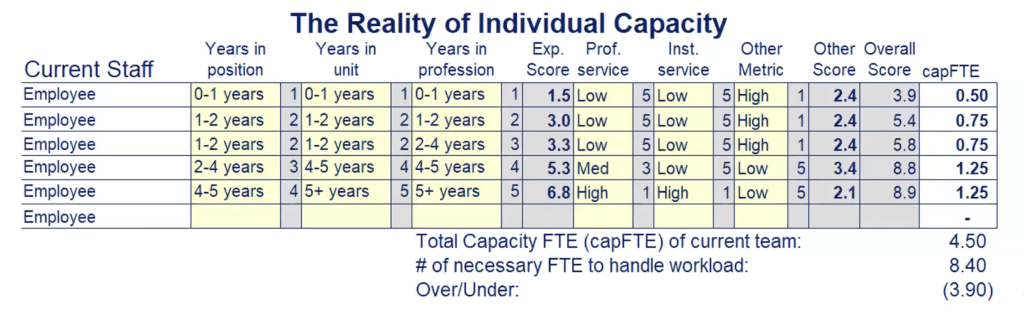
Lacey’s method quantifies several factors on a 1–5 or low-to-high scale, then calculates a capFTE value ranging from 0.5 to 1.5. The factors considered fall into one of two broad categories: experience, including years in a position, years of experience, and years in the profession, and other less numerically quantifiable factors, including adeptness at professional service and institutional service.
However you choose to calculate capFTE values, it is important to remember that these are not intended for use in measuring performance. An employee who processes more proposals than another may have a higher capacity, but they may perform worse than other team members for reasons that fall outside of our capFTE scores, like cooperation or responsiveness.
Bringing it all together
With our more accurate measurements for person-hours, task-hours, and employee capacity taken into consideration, we can now turn to the recommended updated formula for measuring workloads:
(Expanded tasks times the number of Hours needed to complete tasks), divided by (2,080 hours minus Investment tasks), equals the required capacity of Full Time Employees, or (E*H)/(2,080-I)=capFTE.
While no formula can calculate exactly how many hours you’ll spend on each task every year, this updated method for assessing workloads will help create as accurate an assessment as possible so you can focus on spending resources where they matter most and keeping team members engaged and happy with their roles.
These measurements can inform important questions, including:
- How many employees do we actually need?
- What are we actually responsible for?
- Which tasks are taking us the longest?
- Which tasks should be reassigned or eliminated?
Remember: at the end of the day, workload measurements shouldn’t be used to determine how few employees your team needs, but rather how resources can be allocated to ensure your team can complete the necessary work without experiencing burnout. Realistic workloads mean better productivity, higher employee satisfaction, and ultimately more success.
